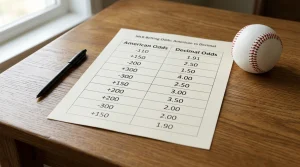


Every analytical baseball career has a moment that sticks. Mine was a Wednesday afternoon in 2019 – Astros at -300 moneyline, -1.5 run-line at +135 – when I split a stake fifty-fifty between the two markets to see how the maths actually behaved over a sample. Houston won 7-2. The lesson was sharper than the win itself: the moneyline-vs-run-line decision is a price-and-margin question dressed up as a strategy question, and the right answer changes from game to game. Nine years later, I still take the decision seriously every time. Roughly thirty per cent of all MLB games are decided by a single run, which is the structural reason a -1.5 run-line exists at all. This piece walks through when to take the run-line over the moneyline and, more importantly, when not to.
Definitions Side by Side
I once watched a friend who was new to baseball place a -1.5 run-line on the Yankees because the price looked better than the moneyline, then ask why his bet had lost when the Yankees won. The lesson stuck because the confusion was honest.
The MLB moneyline is the simplest market in the sport. You pick a winner. The price reflects the implied probability of that team winning, with the bookmaker’s margin baked in. A 1.40 favourite is implied to win roughly seventy-one per cent of the time on the price; the actual probability is slightly lower because of the margin.
The run-line is the standard MLB handicap, fixed at ±1.5 runs. A favourite at -1.5 must win by two runs or more for the bet to land. An underdog at +1.5 covers if the team wins or loses by exactly one. The structure is fixed because of the underlying mathematics – when thirty per cent of MLB games are decided by exactly one run, a one-and-a-half-run handicap creates a meaningful and reliably-priced second market alongside the moneyline.
The numerical difference matters. A 1.40 moneyline favourite often shows up at +1.10 to +1.20 on the -1.5 run-line, and the implied win-by-two probability drops to around forty-five to fifty per cent depending on the matchup. The bet is no longer “who wins” but “who wins by two.” Those are not the same question, and the price spread is the market’s way of telling you so.
The Heavy-Favourite Cost Curve
Here is the real reason punters flirt with the run-line. The cost of laying a heavy MLB moneyline favourite is uncomfortable to most people. A 1.30 favourite returns thirty pence on the pound – you have to be right roughly seventy-seven per cent of the time before margin to break even, and on a single bet that does not feel like a generous risk-reward.
The run-line on the same team typically reprices the wager dramatically. A 1.30 moneyline favourite at -1.5 might sit between +1.50 and +1.80 depending on the pitcher matchup and the venue. The implied win-by-two probability drops accordingly, and the pay-off ratio improves to something that looks more like a coin-flip with edge than a near-certainty with a thin reward.
The cost-curve trap, though, is that the win-by-two probability for a 1.30 favourite is not always materially higher than the implied probability of a +1.50 underdog covering on the moneyline. Heavy favourites are heavy favourites for a reason – usually a pitcher mismatch – and that mismatch often produces tight games rather than blowouts because the favourite’s offence does not have to do much to win. A 1.30 line implies seventy-seven per cent moneyline probability; the underlying win-by-two probability often sits around fifty per cent, sometimes less. The run-line at +1.60 might be priced fairly, slightly favourably, or slightly unfavourably, and the only way to tell is to model the matchup.
Underdog Plus One and a Half – The Quiet Edge
The underdog +1.5 run-line is the most consistently underrated MLB bet on a UK card. The reasoning is straightforward: when thirty per cent of all MLB games are decided by exactly one run, an underdog who wins straight up plus an underdog who loses by one combine to land somewhere between fifty-five and sixty-five per cent of the time on most pricing models, depending on the underdog’s quality and the venue.
The catch is that the underdog +1.5 is also priced accordingly. A +160 moneyline underdog often shows up at -1.65 to -1.85 on the +1.5 run-line, which means you are paying roughly two-thirds of a unit to receive one unit on the cover. The implied probability is around fifty-eight to sixty-five per cent, and you are typically right that often when the underdog has a competent starter and the favourite is not in walk-off-loss territory.
The trap is when the underdog has a weak bullpen. A +1.5 run-line on an underdog with a fragile late-inning corps cashes when the underdog leads through six innings – but the bullpen variance is exactly the variance that pushes a one-run game into a three-run loss in the eighth and ninth. Filter your underdog +1.5 plays by bullpen ERA, leverage index, and recent usage. The good underdog +1.5 bets share a profile: competent starter pitching deep enough into the game that the bullpen exposure is contained.
The Closing Pitcher Effect on Late Pricing
The single most underrated factor on a run-line is the closer’s status. When a tight game enters the eighth with a one-run lead, the closer’s identity drives the run-line price. A closer with a sub-2.50 ERA over a defined trailing sample – and the average MLB game length now sits at around two hours and thirty-eight minutes, which means the closer enters with the game tightly compressed and the bullpen lever fully active – is statistically more likely to produce a one-run save than a three-run insurance gap. A favourite team with a dominant closer locks in tight wins, which favours the underdog +1.5 over the favourite -1.5.
The contrast is a closer in slump. A closer with three blown saves in the trailing ten outings reprices the same fixture sharply – the favourite -1.5 becomes more attractive on insurance grounds because the ninth inning becomes more volatile, and the underdog +1.5 becomes more dangerous because a blown lead can cascade into a three-run swing in the wrong direction. The closer’s status is the kind of context the public model captures imperfectly, particularly mid-week, and that imperfection is where a UK punter willing to do the homework finds repeatable edge.
A Decision Framework You Can Use on Tuesday Night
I run a four-question filter every time I have to decide between moneyline and run-line. First, is the favourite shorter than 1.40 on the moneyline? If yes, the run-line is worth pricing. If no, the moneyline usually pays its own way at acceptable risk. Second, what is the favourite’s record at -1.5 over the trailing forty starts of the listed pitcher? If the cover rate is below forty-five per cent, the run-line is unattractive even at apparently generous prices. Third, is the bullpen state of either team flagged for slumps or fatigue? If yes, the favourite -1.5 takes on additional risk and the underdog +1.5 takes on additional value. Fourth, is the venue compressed or expanded by weather and park factors? Coors Field expands run distributions and makes the favourite -1.5 more reliable. Petco Park compresses run distributions and makes the underdog +1.5 noticeably stronger.
That four-question filter is not a model. It is a discipline. The full mathematical treatment of run-line pricing – closing-line value, vig accounting, sample-size requirements – sits inside the broader work on baseball pricing, and for context across the wider catalogue of MLB market types, the markets explainer walks through the structural picture. The point of the filter is to stop you from defaulting to whichever market shows the longer price on screen. The longer price is the bookmaker’s pitch, not your edge.
The honest summary is that the moneyline and the run-line are two prices on the same underlying matchup, and the right bet is the one whose implied probability is furthest below the modelled probability after the bookmaker’s margin is removed. That is the question. Everything else – the headline price, the marketing, the recent narrative – is noise around it.
Is the runline always the right play when the moneyline favourite is shorter than 1.40?
How does a closer's price-shift affect a late runline value?
Material created by the team StitchLine