

One of the things people rarely understand about baseball outside North America is the sheer size of its global infrastructure. The World Baseball Softball Confederation oversees 208 national federations across 141 countries, with a participating-athlete base of around 65 million and an in-stadium fan footprint estimated at 150 million annually. MLB is the marquee league and the headline brand. It is also one of perhaps a dozen serious baseball ecosystems worldwide, each with its own competitive rhythm, its own betting market, and its own structural opportunity for a UK punter willing to look further than the New York Yankees.
I have been pricing baseball outside the MLB envelope since 2018, mostly because the schedule of NPB and KBO sat far better with European time zones than late-night MLB ever did, and partly because the markets in those leagues are softer than the MLB grid. What follows is the framework I use for international baseball as a UK punter — the leagues, the betting markets, the time-zone arithmetic, and the reasons not every international competition is worth the same kind of attention.
Why UK punters look beyond MLB at all
Nielsen’s SportsDNA tracking puts UK adult interest in MLB at a stable 8% across the 16-69 age band — meaningful, not enormous, and a long way short of the 42% interest figure the same survey records for Japan or the 24% it records for Mexico. The implication is not that MLB is unpopular in the UK; it is that MLB sits as one international sport among many for the UK punter, and the case for trading it exclusively is weaker than the marketing copy suggests.
The case for trading international baseball alongside MLB is partly schedule-driven and partly market-driven. NPB’s regular season runs March to October with most games starting at 6pm Japan Time — that translates to a start window of 9am to 11am UK depending on the part of the year, which is a far better fit for someone who works during the day and watches sport at lunch than a midnight first pitch in Boston. KBO’s window is comparable. The London Series brings live MLB to a UK afternoon for the only time in the calendar.
The market-driven case is sharper. The MLB pricing engines at the major UK books are tight, fast and well-resourced; they do not give away much. The same engines, applied to NPB or KBO, are typically running on thinner data feeds and with less trader oversight, which leaves more room for a sharp UK punter to find lazy lines. The 208-federation base in the WBSC structure points to an even longer tail of competitions where the trader has barely glanced at the form data at all.
None of this argues against MLB as the punter’s bread and butter. The argument is that the UK MLB punter who does not also know NPB and KBO is leaving meaningful edge on the table — both in market depth and in time-zone convenience.
NPB Japan — the league with 42% domestic interest
Nippon Professional Baseball is the largest professional baseball league outside MLB by paid attendance, broadcast revenue and structural depth. Twelve teams across the Central League and the Pacific League, a 143-game regular season, a Climax Series playoff format and the Japan Series final. The standard of play sits roughly comparable to AAA-Triple-A MLB ball at the lower end and, on the Pacific League’s strongest evenings, comparable to a mid-tier MLB lineup. Japan’s 42% adult interest in baseball — five times the UK’s interest in MLB — explains the depth of the domestic market and the maturity of the live-TV infrastructure built around it.
The structural differences from MLB matter for the UK bettor. NPB games are slightly longer than the post-pitch-clock MLB game — Japan has not adopted the pitch clock — averaging closer to 3 hours 10 minutes. The strike zone is called more conservatively. Pitchers are deployed differently; starters typically work deeper into games, the closer concept is more rigid, and the manager’s bullpen patterns are more predictable than the MLB equivalent. Pitchers throw fewer pitches per appearance than MLB starters, but the appearance windows are shorter and rotation gaps are longer — six-man rotations are the norm, not the exception.
The betting markets at UK books that carry NPB are usually a stripped-down version of the MLB grid. Moneyline on every game; run line at ±1.5 on most games; total at the standard NPB run line of around 7 (lower than MLB’s 8.5 because the league scores fewer runs); a handful of pitcher props on the most-bet matchups; occasional team-total markets. Derivative innings markets are rare. Live grids are thinner than MLB’s; the pricing engine often suspends entire markets rather than try to keep up with in-play movement.
Where the NPB punter finds value is in the data asymmetry. UK bookmakers’ pricing models for NPB are usually built off public statistics — Yakyu Reference, the league’s own published tables — without the proprietary modelling depth that MLB pricing has. A UK punter who reads Japanese baseball coverage, tracks rotation announcements through Japan-side news rather than next-day English summaries, and understands the manager-driven bullpen patterns that the league’s culture produces can find run-line and totals value that the MLB market simply does not give up any more.
KBO Korea — bat flips, six-team playoffs and softer lines
The Korea Baseball Organization runs a ten-team league with a 144-game regular season and a five-team playoff structure that produces a single Korean Series champion in November. The level of play sits below NPB’s Pacific League standard but the infrastructure — broadcast quality, in-stadium experience, advanced statistics availability — has caught up dramatically over the past decade.
The KBO is also, frankly, more entertaining than most baseball leagues to watch. The bat-flip culture — celebrating a home run with a deliberate, theatrical flip of the bat — is part of the league’s identity in a way that would draw a fastball at the next at-bat in MLB. Crowd-engagement traditions, the unique horn-and-whistle stadium soundtrack, and the rotating regional rivalries combine into a game that watches differently from MLB and rewards a punter who has spent enough time with the league to read its rhythms.
The market structure is similar to NPB. UK bookmakers carrying KBO list moneyline, run line and totals on most games; a handful run pitcher and team-total props on the bigger matchups; live grids are limited and frequently suspended. The 8% UK adult interest figure for MLB drops further for KBO — KBO has effectively no measurable UK retail demand — which is precisely why the market is structurally softer. Liquidity is thin, but so is the trader’s attention.
The recurring KBO edges I have found over the past several seasons sit in three places. The first is starter-fatigue patterns; KBO starters work on a six-day rotation and the late-rotation start in a tight series is more vulnerable than the trader’s pre-game line suggests. The second is umpire-tendency adjustments; KBO umpires call a tighter strike zone than MLB on average, and the same total-line moves differently from week to week depending on which umpire crew is working a particular series. The third is the late-season playoff-positioning effect; teams locked into the playoffs treat the final fortnight differently from teams chasing a wild-card spot, and the run-line market does not always reprice that motivation gap.
The time-zone advantage — Asia baseball at UK lunchtime
The arithmetic is simple. NPB games starting at 6pm Japan Time hit a UK clock at 9am to 10am depending on the British summer-time window. KBO games starting at 6:30pm Korea Time hit at 10:30am UK in summer or 9:30am in winter. Weekend KBO double-headers fit a Saturday lunchtime perfectly. NPB Japan Series games in late October finish around 1pm UK on a Tuesday afternoon — comfortably before most UK desk-workers have finished their lunch break.
That schedule matters because the alternative — staying up until 3am to watch a 7pm Eastern MLB game finish in the Bronx — is a known sleep cost and a known performance cost on next-day decisions. International baseball at UK lunchtime is not just a convenience; it is a structural advantage for the punter who wants to make decisions when their cognition is fresh, not at the end of an eighteen-hour day.
The associated trade-off is information density. UK-side coverage of NPB and KBO is thin compared with the avalanche of MLB media that fills English-language sports sites. A serious international-baseball punter ends up reading machine-translated Japanese rotation announcements, following the league sites directly, and tracking Korean baseball Twitter accounts for late-breaking lineup news. The information barrier is real but it is also the source of the edge — the trader does not have it either, in many cases.
The London Series — the only MLB on UK soil
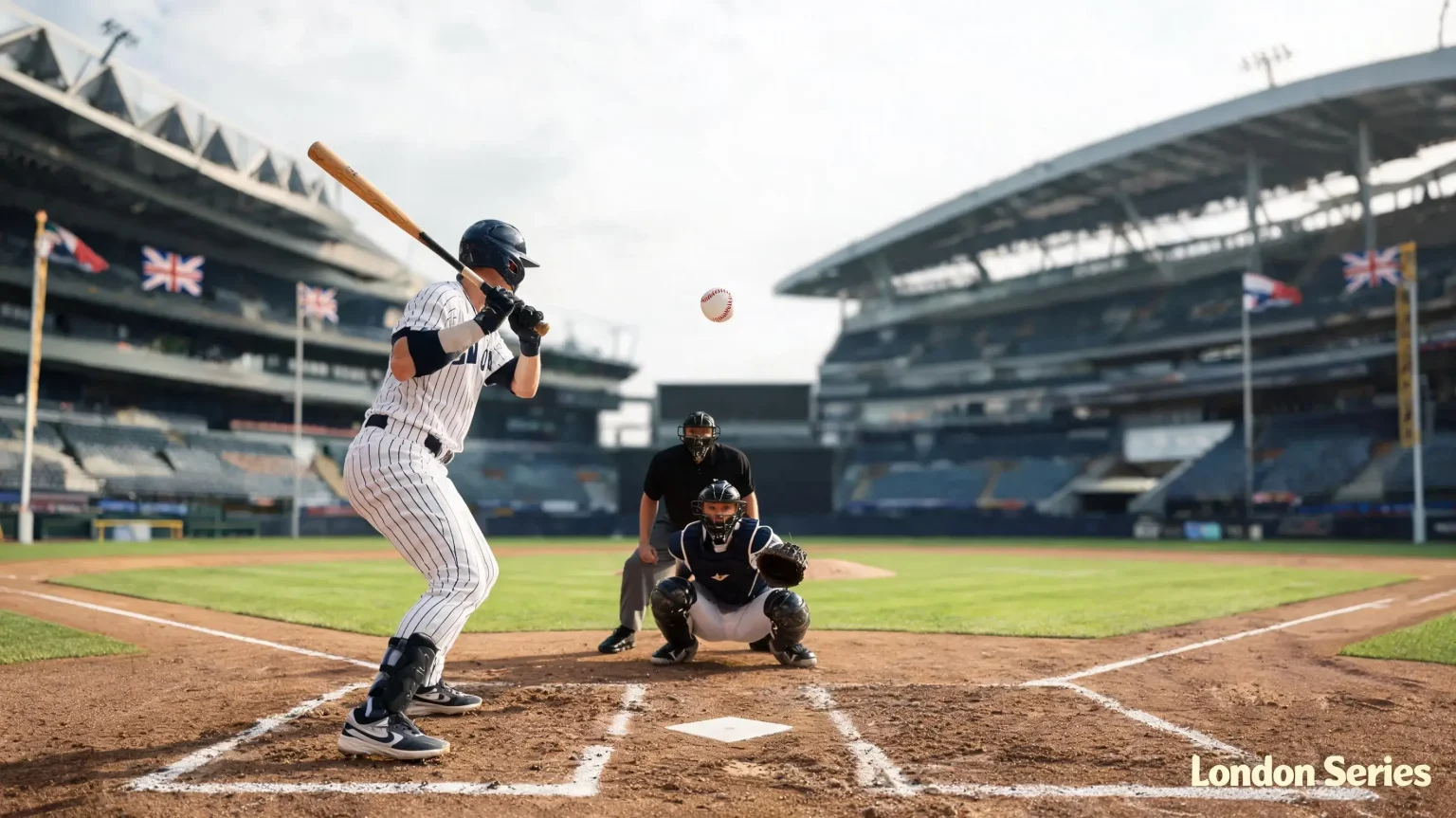
The London Series — MLB regular-season games staged at the London Stadium — is the single annual event that brings the headline league physically to the UK. The 2023 staging of the Cubs against the Cardinals drew an average attendance of around 55,000 across the two games, with 71% of attendees identifying as UK residents. The associated commercial impact was meaningful: MLB’s UK social-media audience grew 133% in the months around the series, and merchandise sales rose 43% on the same baseline. The 2019 series sold 120,000 tickets in under an hour.
What the London Series does for the UK punter is collapse the time-zone problem entirely. Games start at UK afternoon kick-off times, played in London, broadcast live on UK terrestrial sport, with full bookmaker coverage including a live grid that is comparable in depth to a normal MLB regular-season day. Every UK-licensed operator that prices MLB at all prices the London Series in full. Promotional offers concentrate on the series. Match-day attendance is genuinely viable for UK punters who want to be in the stadium.
The market quirk worth knowing: London Series prices tend to attract more UK retail money than the equivalent regular-season fixture played in the US. That retail money skews the moneyline towards public favourites, which creates value on the run line and on totals for the punter willing to fade the public flow. The 2026 series — full schedule and team announcement detail — sits in a deep dive on the 2026 London Series betting card, including the specific market quirks the public-money-flow effect produces.
The World Baseball Classic and other international windows
The international-tournament windows — the WBC every four years, the Premier12 in non-WBC years, regional qualifiers — produce concentrated betting markets with very different structural properties from regular-season league play. National teams replace club teams. Roster construction reflects player availability rather than long-term squad building. The competition format is short — pool play followed by knockouts — which means a tournament can produce ten or twelve genuinely meaningful games in a week.
The viewership argument for paying attention to international baseball is increasingly hard to dismiss. The 2025 World Series Game 1 between the Blue Jays and the Dodgers drew an average combined audience of 32.6 million across the United States, Canada and Japan — the largest combined cross-border MLB audience since 2016, and a clear empirical signal that baseball’s international footprint is real and expanding. International tournament windows tap into the same audience structure with stronger national-team narrative pull.
For the UK punter, the WBC and similar tournaments produce two distinct betting opportunities. The first is outright tournament winner — placed before pool play begins, settled at the final, with prices that move dramatically through the seven to ten days of group play. The second is individual-game moneyline and totals, where the data quality varies enormously between high-information matchups (US vs Japan) and low-information matchups (qualifying-round games between secondary national programmes). The data asymmetry is the value.
Caribbean and winter ball — the off-season punters miss
Latin American winter ball — the leagues running in the Dominican Republic, Venezuela, Mexico, and Puerto Rico through November to February, culminating in the Caribbean Series — is the off-season baseball most UK punters do not realise exists. The standard of play is uneven, ranging from genuine MLB-quality talent at the top of rosters to journeymen filling out the lineups, but the betting markets are thin enough and the trader attention is light enough that genuine line-quality issues sit on the board most weeks.
The Caribbean Series itself — the round-robin tournament between the four winter-ball league champions, played in late January or early February — produces a concentrated week of cross-league baseball with full bookmaker coverage at any UK operator that prices winter ball at all. Game start times are largely Caribbean evening, which translates into UK morning, perfect for a Saturday breakfast bet but awkward for a midweek fixture.
The structural reason winter-ball markets carry value is that the trader is pricing them with a fraction of the data infrastructure they apply to MLB. Public statistics are sparse, broadcast quality is variable, and the player movement between teams during a single winter-ball season — a major-league prospect arriving for ten games before being recalled to spring training — produces line-quality issues that the MLB pricing engine would never tolerate. For a UK punter willing to do the homework, winter ball is one of the few remaining frontier markets in baseball betting.
Which UK bookmakers actually cover non-MLB baseball
The remote-betting GGY in the UK reached £2.6 billion in the most recent reported financial year, with the bulk of that volume concentrated on football and racing. Baseball overall is a small slice of that figure. Non-MLB baseball — NPB, KBO, winter ball, international tournaments — is a smaller slice still. The UK operators that cover those markets seriously can be counted on the fingers of one hand.
The structural pattern: any UK book pricing MLB will also price the WBC and the London Series, because both events are calendar peaks the trader cannot afford to miss. NPB and KBO coverage is more variable; some operators carry full season coverage, others carry headline games only, and a handful have dropped Asian baseball coverage entirely since the November 2025 micro-bet rules added compliance overhead. Winter-ball and Caribbean Series coverage is the rarest, typically only carried by the operators that pride themselves on broad sport coverage.
What to check before assuming an operator covers a given league: the live A-Z sports list during the season window, the in-play offering during a typical game, and the available market depth on a non-headline matchup. A book that lists NPB but only offers moneyline on the headline rivalry games is not a serious NPB book; it is a marketing claim. A book that offers run line, totals and a handful of pitcher props on a weeknight Pacific League fixture is a book where the trader has actually built out the league.
Liquidity, line quality and the realistic stakes
Non-MLB baseball at UK books carries lower liquidity than MLB and lower maximum stakes per market. The trader is happy to take a £30 stake on a KBO moneyline; less happy to take a £300 stake; sometimes outright unwilling to take a £1,500 stake on the same market without manual approval. That ceiling is the structural limit of the strategy. International baseball is a low-stakes, high-frequency edge; it is not a vehicle for large position-taking unless you are running multiple operators simultaneously.
The line-quality compensation for the lower stakes is real. A book willing to take £30 on a soft KBO line at the trader’s offered price is an edge worth working through the season; the same edge applied across thirty bets a week through the regular season produces meaningful return on time invested. The discipline is to accept the stakes ceiling rather than try to push past it — pushing past triggers the operator-side review that ends with the account flagged for limits and the edge effectively lost.
Why the international book is open right now
The MLB commercial team’s own framing summarises why international baseball is having an extended commercial moment, and why the betting markets around it are growing in step. As Uzma Rawn Dowler, MLB’s Chief Marketing Officer, put it in late 2025, “Baseball is having a moment. We are on fire right now, and it’s not just around the postseason, which has been incredibly electric.” Her angle was the marketing rebound across the audience numbers; the side effect for the UK punter is that the league, the international audience and the bookmaker grid have all expanded in parallel. NPB pricing is deeper than it was three years ago. KBO pricing is more accessible. The London Series is fixed in the UK calendar. The Caribbean Series carries proper run-line markets at the larger UK books. The international baseball book has never been broader for a UK punter willing to learn the schedules and build the modelling base. The window is open. Whether you walk through it depends on whether you treat the schedule as an inconvenience or an advantage.
Are KBO and NPB markets thinner because UK bookmakers price them less actively?
How does the WBSC's tournament structure change tournament outright pricing?
Why do Caribbean Series night games clash with UK morning hours?
Material created by the team StitchLine