

The first time a friend asked me to explain “what’s a run line in baseball” without using the word “spread”, I realised how much of the standard MLB-betting glossary is borrowed from American football and basketball, and how little of it lands cleanly on a UK punter who grew up on accumulators and ante-post horses. Run line is not handicap. Moneyline is not match-winner with a draw option. Totals are not Asian over/unders. Each MLB market has its own internal logic, shaped by the fact that around 30% of all MLB games are decided by a single run.
What follows is the working glossary I wish someone had handed me when I first started pricing baseball in 2017 — every market the average UK book lists, what it actually means, a UK-decimal example, and where the pitfalls hide. No US slang without a UK translation. No “juice” or “vig” — that is overround, the same way it is on a football coupon.
Moneyline — the simplest, lowest-margin MLB market
The moneyline is which team wins the game. That is the entire market. Extra innings count, the result settles when the final out is recorded, and a tied game suspended by weather is usually voided rather than priced as a draw — most UK books no longer list a draw on standard MLB moneylines, because regular-season MLB does not produce ties under current rules.
A typical moneyline matchup might look like Yankees at 1.62 to win, Red Sox at 2.40. The implied probabilities are 61.7% Yankees, 41.7% Red Sox; the sum is 103.4%, and the margin is 3.4%. That is at the low end of UK MLB pricing — moneylines are the most efficient market on the board because every operator checks them against every other operator, and the trader cannot afford to be wide. A book consistently pricing standard moneylines at 5% or 6% margin is signalling either a thin liquidity model or a structural disinterest in baseball.
Where moneyline goes wrong for new punters is staking discipline. A 1.30 favourite priced honestly is still a 23% loss every time the favourite drops the game, and 23% on starter-pitcher MLB happens roughly two times in every nine games. Stack three short-priced moneylines into an accumulator and the cumulative variance grows fast — a 1.30 / 1.40 / 1.45 four-fold pays a touch above 2.6, but the underlying probability of all three landing is around 38%. Pricing in your own probability is the only defence; trusting the marketing copy on a “banker” is not.
The signal moneylines do still send is the relative price between two books on the same matchup. Pick three UK-licensed operators, write down the same Tuesday-morning price on the same game, and the spread tells you which book has the trader paying attention.
Run line — the ±1.5 that is not a handicap
The run line is MLB’s standard handicap, and it is fixed at ±1.5 by convention rather than at variable lines like NFL spreads. The favourite gives 1.5 runs (must win by two or more); the underdog gets 1.5 runs (loses by one, draws, or wins outright). The spread is fixed; the price moves with the matchup. A heavy favourite on the moneyline at 1.50 might price out at 2.00 or 2.10 on the run line because the half-run buffer is doing real work.
Why ±1.5 specifically, and why it matters for UK punters is the same answer twice. Roughly 30% of MLB games are decided by exactly one run, which is structurally why the half-run buffer is non-trivial. A favourite at 1.50 on the moneyline who is genuinely the better team will, in expectation, win two-thirds of the time — but a meaningful slice of those wins will be one-run games. The run line at -1.5 prices that probability gap directly. It is the same matchup, repriced for the buffer.
A UK-decimal example: Yankees -1.5 at 2.10 means I need the Yankees to win by two runs or more. If they win 4-3, the moneyline cashes and the run line loses. If they win 6-2, both cash. The price at 2.10 implies a 47.6% probability that a 1.50 moneyline favourite covers by two — and that figure should, in any reasonable model, line up with the matchup’s actual win-by-two rate to within a couple of points.
Where the run line trap lies is in chasing the inflated price on a heavy underdog at +1.5. A team priced at 4.00 on the moneyline drops to roughly 1.45 at +1.5 because the buffer flips into their favour. The market is not gifting you anything; it is just repricing the same probability with a different cut-off. The question is not “do I want plus runs”, it is “is the +1.5 price out of line with the actual cover rate”. If yes, take it. If no, you are trading the same probability at a worse implied edge.
Totals — over/under, weighted by pitch clock and umpire
The total is the bookmaker’s number for combined runs scored by both teams. You bet over or under that number, and the .5 in the standard 8.5 or 9 line exists for the same reason it does on the run line — to remove the push.
What changed in 2025 is the underlying baseline. The pitch clock — introduced in 2023, refined further since — has compressed the average MLB game time to 2 hours 38 minutes, the third consecutive year sitting under 2:40 and the first such stretch in 40 years. Only three nine-inning games went over 3:30 in all of 2025, against 391 such games in 2021. Shorter games structurally affect runs scored, because fewer pitching changes, fewer batter resets and fewer late-bullpen innings change the run-environment math at the margin.
The practical implication for UK totals punters: the historical “average” total of around 8.5 to 9 has migrated. Some game environments — Coors Field at altitude, or hot Dome games in hitter-friendly parks — still push totals to 10.5 or higher. Pitcher-strong matchups in cold-weather April games trim back to 7.5 or 8. The market has adjusted; the trick is not to anchor your model to pre-2023 norms.
A UK-decimal example: Astros vs Mariners over 8.5 at 1.90, under 8.5 at 1.95. Sum the implied probabilities: 52.6% over plus 51.3% under equals 103.9% margin. Standard. The interesting question is whether the line itself is right, not whether the over/under split is symmetric. That is where weather, umpire strike-zone tendency and bullpen rest become the inputs that actually move money.
Alternate run lines and totals — when ±1.5 is not enough
An alternate market lets you choose a non-standard handicap or total — typically ±2.5, ±3.5 or even ±4.5 on the run line, and totals stepping in half-run increments from 6.5 up to 11 or 12. The price moves to compensate.
An alternate run line at +2.5 on a heavy underdog might price out at 1.18 — a probability cushion that will land, on average, but at a price that punishes a single bad night. An alternate -2.5 on a strong favourite could be priced at 4.50, valuing the win-by-three outcome at 22.2% implied. Both are legitimate plays in the right context. Both are also where impatient punters lose money fastest, because the surface logic (“I’m getting more runs, bigger price”) obscures the underlying cover rate.
The alternate-totals market is more useful for shaping a directional view on a specific matchup. If your model says the actual line should be 7 in a pitcher-favourable matchup that the book has hung at 8, taking under 7 (or under 7.5) at a longer price is a sharper expression of the view than taking under 8 at near-even money. The book has already sold you the half-run buffer for free; the longer alternate is where you express conviction.
Team and game props — totals, runs in innings, and yes/no markets
Team and game props are the markets that are not strictly moneyline, run line, or game total — but cover the same game from different angles. The most-used ones in UK MLB books are team totals (over or under a team-specific run number), run-in-the-first-inning yes/no, NRFI/YRFI (no run first inning / yes run first inning) and the various run-in-X-inning specials.
NRFI is the headline derivative because it concentrates the entire bet on the first half-inning of action — fifteen pitches, two top-of-the-order at-bats per side, no late-game leverage, just whether either team scores in the first. The price tends to sit between 1.70 and 2.00 on either side, and sharp punters have built whole models off NRFI alone using starting-pitcher first-inning ERA splits and lead-off-hitter on-base rates.
Team totals are the workhorse. They strip out the opposing team’s offence and let you express a directional view on one side of the matchup. Yankees over 4.5 runs at 2.00 is a different bet to Yankees moneyline at 1.62; the two might not even correlate strongly on a given night, because the Yankees can score five and lose, or score three and win. Pricing a team total honestly is the test of whether a book takes derivative depth seriously.
The pitfall: derivative props are also where the trader updates the line slowest. That cuts both ways. You can find lazy lines an hour before first pitch — and you can also be the slow money trying to take a price the trader has already pulled.
Pitcher and batter props — and the November 2025 micro-bet rule
Pitcher props are the strikeout market, the earned-runs market, the outs-recorded market and the win-decision market. Batter props are the hits, total bases, runs and RBIs markets. Both come in standard over/under shapes (e.g., Strikeouts over 7.5 at 1.85). Both are popular with US-style sharp punters, and both have driven a meaningful share of MLB betting volume.
The big change for 2026 is regulatory rather than technical. Following a corruption investigation in late 2025, MLB introduced a $200 cap on pitch-level prop bets and excluded those props from parlays. The cap and the parlay exclusion now apply across operators representing 98% of the US betting market. UK-licensed operators have followed in step on the same MLB-affiliated framework, even though the regulatory authority differs.
The reaction from inside the industry was sceptical of the depth of the original market in the first place. As the consultant Dustin Gouker put it during the wider integrity debate, “Do we need to be able to bet on what the next pitch is, whether it’s a ball or strike? Arguably, not.” His point was less about banning the markets than about whether the volume those markets generated ever justified the integrity exposure. The cap is the answer.
For a UK punter, the practical consequence is straightforward. Pitch-level micro-bets are now a small standalone market, not a parlay leg. Pitcher and batter game-level props (full-game strikeouts, full-game total bases) are unaffected and remain core MLB markets. The detail of how the cap operates — and what it means for accumulator construction — is set out in the 200-dollar pitch-prop cap explained.
Derivative innings — first 3, first 5, last 3
Derivative innings markets price a slice of the game. The two most useful for UK punters are the first-five-innings (F5) markets and the first-three-innings (F3) markets. Each has its own moneyline, run line and total, settled at the end of the relevant inning regardless of what happens after.
The F5 market is the most liquid. It is a clean expression of the starting-pitcher matchup, because the bullpen has not yet entered the game (or has only barely entered) and the line therefore reflects pitcher-against-pitcher pricing rather than full-game variance. F5 unders are a popular derivative because the volatility of late-inning bullpen meltdowns is removed entirely from the bet.
F3 is rarer — typically only the deeper books carry it — and a more concentrated expression of the top-of-order at-bats against the opening starter. The line moves quickly when a starting pitcher is announced as suboptimal (illness, late scratch) less than two hours before first pitch. A punter watching the team lineup announcement closely can sometimes get a price in that window before the trader has updated.
The structural advantage of derivative innings is they isolate the part of the game you actually have a model for. A full-game total stitches together starting-pitcher quality, bullpen quality, lineup quality and in-game matchup adjustments; an F5 total is just the starting-pitcher matchup. Cleaner inputs, narrower variance, the same liquidity at the deeper books.
Futures and outrights — long-dated baseball
Futures, or ante-post in UK racing parlance, are the long-dated markets: World Series winner, league pennant winner, division winner, regular-season win totals, individual MVP and Cy Young awards. The bet is placed weeks or months before the result is known.
The US sports-betting market staked roughly $166.94 billion in 2025 with industry revenue around $16.96 billion, up 22.8% year-on-year. A meaningful slice of that handle moves through baseball futures during spring training and again as the postseason picture clarifies in August and September. UK books generally carry the headline futures (World Series, AL/NL pennants, divisions, win totals) but less consistently the individual-award markets.
The thing about futures is the cash-tied-up problem. A World Series price taken in March cannot be settled until late October or early November. The capital is dead for seven months. That is acceptable on a value play, brutal on a “felt good about it” play. The good UK books offer cash-out on futures, which lets you crystallise a profit (or limit a loss) when the price moves your way, at a cost of a small chunk of expected value relative to letting the bet ride.
Parlays and accumulators — the UK punter’s home turf
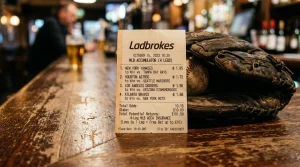
An accumulator and a parlay are the same bet. UK punters call it an accumulator because that is the football-coupon vocabulary; US books call it a parlay; the maths is identical. Multiple selections combined into a single bet, all of which must land for the bet to win, with the price multiplying through.
The MLB accumulator culture in the UK is real and well-established — three-fold and four-fold MLB accas through a regular-season Sunday slate are the standard recreational construction. The pricing is fair (most books layer no extra margin onto accas relative to the singles), but the variance is brutal. Three independent moneyline picks each at 50% probability give the acca a 12.5% landing rate and a price around 8.0. Stretch to four legs and the landing rate drops to 6.25% with a price around 16.0. The maths is not the friend it appears to be.
Acca insurance promotions — refunding the stake if a single leg loses — change the expected value materially. Where the operator funds it, take it. Where the operator funds it but caps the refund at £10 on a £25 bet, calculate the actual EV before assuming the offer is in your favour.
Bet builder MLB — same-game accas with friction
A bet builder, or same-game parlay in US vocabulary, lets you combine multiple markets from the same MLB game into a single bet — for example, Yankees moneyline plus Aaron Judge over 1.5 total bases plus over 8.5 total runs. The book prices the combined probability after adjusting for correlation between the legs.
That correlation adjustment is the critical detail. A naive multiplication of the three single prices would over-pay the bet builder, because the legs are positively correlated — if the Yankees win, Judge probably contributed, and the over is more likely. The book’s bet-builder price strips out that correlation, which is why a same-game three-fold typically prices considerably shorter than the same three legs as separate moneyline accas.
The bet builder is best used to express a single thesis cleanly. “If the Yankees win, it’s because Judge has a big game and the bullpen holds the late lead” is a thesis. Three uncorrelated moneylines is not. The product wins where the punter has a coherent matchup view; it loses where the punter is stitching together vibes.
Where the markets join up
The MLB market grid looks bewildering on a Tuesday morning with twelve games on the slate, but its structure is straightforward once each component is mapped. Moneyline is the priced-down core. Run line is the same probability re-expressed at ±1.5. Totals price the run environment. Alternates let you express stronger or weaker conviction at adjusted prices. Team and game props isolate slices. Pitcher and batter props isolate individuals. Derivative innings isolate game phases. Futures price seasons. Parlays multiply singles; bet builders combine same-game legs at correlation-adjusted prices.
The UK punter who knows what each market does does not need to use all of them — most professionals trade two or three core markets and let the rest sit untouched. What every UK punter does need is a clear view of what the market is, what it is not, and where the pitfalls hide. A book offering ten markets and a book offering two hundred is not “better” or “worse” by raw count. It is suited to a different kind of punter — and the punter that knows which one they are is the punter who finishes the season ahead.
What does an alternate run line at +2.5 actually mean for the bettor?
How does MLB's first-five-innings market sidestep bullpen variance?
When does the 2025 micro-bet rule remove a pitcher prop from a parlay?
Material created by the team StitchLine