

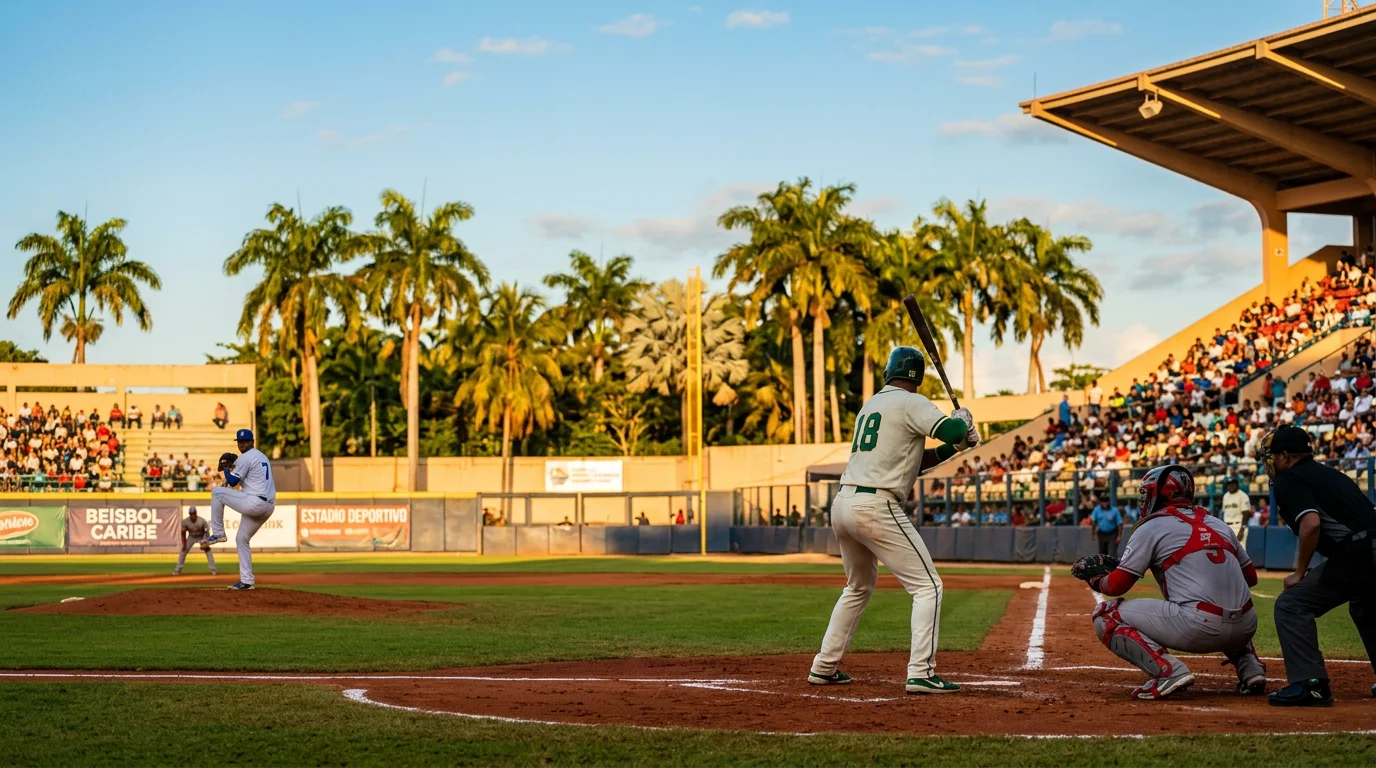
I caught my first Caribbean Series almost by accident, watching a Mexican Pacific League final on a streaming feed at 4am UK time during a long-haul jetlag week, and I have not skipped one since. The tournament is the most underrated event in international baseball, partly because UK bookmaker coverage is thin and partly because the World Baseball Softball Confederation oversees 208 national federations and 65 million participants worldwide without British media giving most of them sustained airtime. The Caribbean Series sits inside that global ecosystem as the showpiece event of Latin American winter baseball, and the betting opportunity around it is genuinely distinct.
For a UK punter willing to engage with late-night markets and modest line depth, the Caribbean Series rewards preparation. The teams are unfamiliar, the player pools rotate annually, and bookmaker pricing reflects that uncertainty in ways that occasionally leave clear value on the board.
Caribbean Series Format
The Serie del Caribe is a round-robin tournament held each February, traditionally featuring the winter league champions of the Dominican Republic, Mexico, Puerto Rico, Venezuela and Cuba, with additional spots filled by Colombia, Nicaragua, Panama or invitational sides depending on the host year. The host nation rotates annually among participating federations. Each team plays a single round-robin against the others, with the top finishers advancing to a semifinal and final.
The compressed format produces a tournament that runs roughly seven days from start to finish. Each team typically plays five round-robin games, with semifinals and a one-game final closing the event. The condensed schedule means pitching staffs are stretched thin by the back end – teams that had a deep regular-season rotation in their domestic winter league often arrive with two reliable starters and a bullpen that needs to absorb most of the workload across the tournament.
That pitching dynamic is the structural feature that drives most of the betting edge in the Caribbean Series. Totals lines tend to drift higher across the tournament as bullpens fatigue, and the back-end games of the round-robin price differently from the opening games even for the same teams. Punters who track the per-team pitching usage day-by-day can build a meaningful informational advantage by the semifinal stage.
Winter Leagues Feeding Into It
Each participating champion arrives from a domestic winter league with its own distinctive character. The Dominican Winter League (LIDOM) runs October through January and features the highest concentration of MLB-affiliated talent of any winter circuit – many AAA and 40-man-roster players spend the winter playing for Tigres del Licey, Aguilas Cibaenas, Toros del Este or Estrellas Orientales. The Mexican Pacific League (LMP) runs a similar calendar with a slightly different player pool, drawing more heavily from Mexican League regulars alongside MLB-affiliated names.
The Puerto Rico Baseball League (LBPRC) and the Venezuelan Professional Baseball League (LVBP) round out the traditional core, with Cuba’s Serie Nacional contributing the Cuban representative when participation aligns. Mexico’s broader baseball culture is reflected in the Nielsen MLB-interest survey figure of roughly 24%, well above the UK’s 8% but below Japan’s 42% – baseball is genuinely embedded in Mexican summer and winter rhythms, and the LMP champion typically arrives in the Caribbean Series with depth and confidence.
The strength of each domestic winter league varies year to year based on which MLB-affiliated players choose to play winter ball and which teams they sign with. That rotation is part of why pricing models trained on the previous season’s Caribbean Series results frequently miss – the rosters genuinely change. For punters interested in another non-MLB ecosystem with deep markets, the structural parallel is informative, though NPB rosters are far more stable year-on-year than Caribbean rosters are.
Betting Line Availability UK
Caribbean Series coverage at UK-licensed operators is thinner than for KBO or NPB. Bet365 typically opens moneyline and totals lines for each round-robin game during the tournament week, with run-line equivalents available on the bigger matchups. William Hill and Paddy Power offer selective coverage, primarily on the semifinals and final. Ladbrokes and Coral often skip the round-robin stage entirely and price only the closing fixtures. Betfair Exchange lists Caribbean Series games sporadically, with liquidity that can be measured in the hundreds rather than thousands of pounds matched per market.
The thin market depth is itself the betting feature. UK book traders often work from imported lines rather than building their own models for events with limited historical data, which means a price posted at midnight on a Tuesday might be slow to react to a starter announcement that breaks in Spanish-language Caribbean media at 11pm UK time. The window between line publication and first pitch is typically where the cleanest opportunities arise.
Prop markets are essentially absent. Strikeout overs, hit-totals and player props rarely list for Caribbean Series games at UK books, and where they do appear the limits are low enough that staking discipline matters more than usual.
Late-Night UK Schedule Overlap
Caribbean Series games are typically scheduled for evening starts in the host country, which translates to late-night and overnight UK time depending on which Caribbean time zone the host occupies. A 7pm first pitch in the Dominican Republic (UTC-4 in February) is midnight UK time. A 7pm first pitch in Mexico (UTC-6 or UTC-7 depending on host city) is 1am or 2am UK time. Doubleheader days can stretch coverage from late evening UK through to 5am.
For UK punters that schedule is harsher than KBO or NPB. The Caribbean Series window is genuinely overnight, with no commute-friendly morning option. The audience that engages with these markets seriously from a UK terminal tends to be either night-shift workers, jet-lagged travellers or punters who treat the tournament as a one-week sprint rather than a sustainable rhythm.
That schedule scarcity contributes to the line softness. Fewer UK eyes on these markets in real time means fewer corrective bets, which means stale prices stay stale longer than they would in a market with continuous attention.
Value Spots in Thin Markets
The reliable value patterns I have tracked across Caribbean Series tournaments cluster in a few specific spots. Late round-robin games where one team is eliminated and resting starters tend to produce mispriced totals – UK books often fail to adjust the line downward despite the obvious quality drop in the resting-starter side. Run-line favourites in the semifinals are systematically overpriced relative to the matchup data, because limited UK trader engagement defaults to safer pricing.
The final itself is the sharpest market and the hardest to beat. By that point line movement reflects multiple feeds and the closing price tends to be efficient.
Are Caribbean Series lines mispriced because UK bookmakers cover them lightly?
Which winter league produces the strongest Caribbean Series teams?
Material created by the team StitchLine