

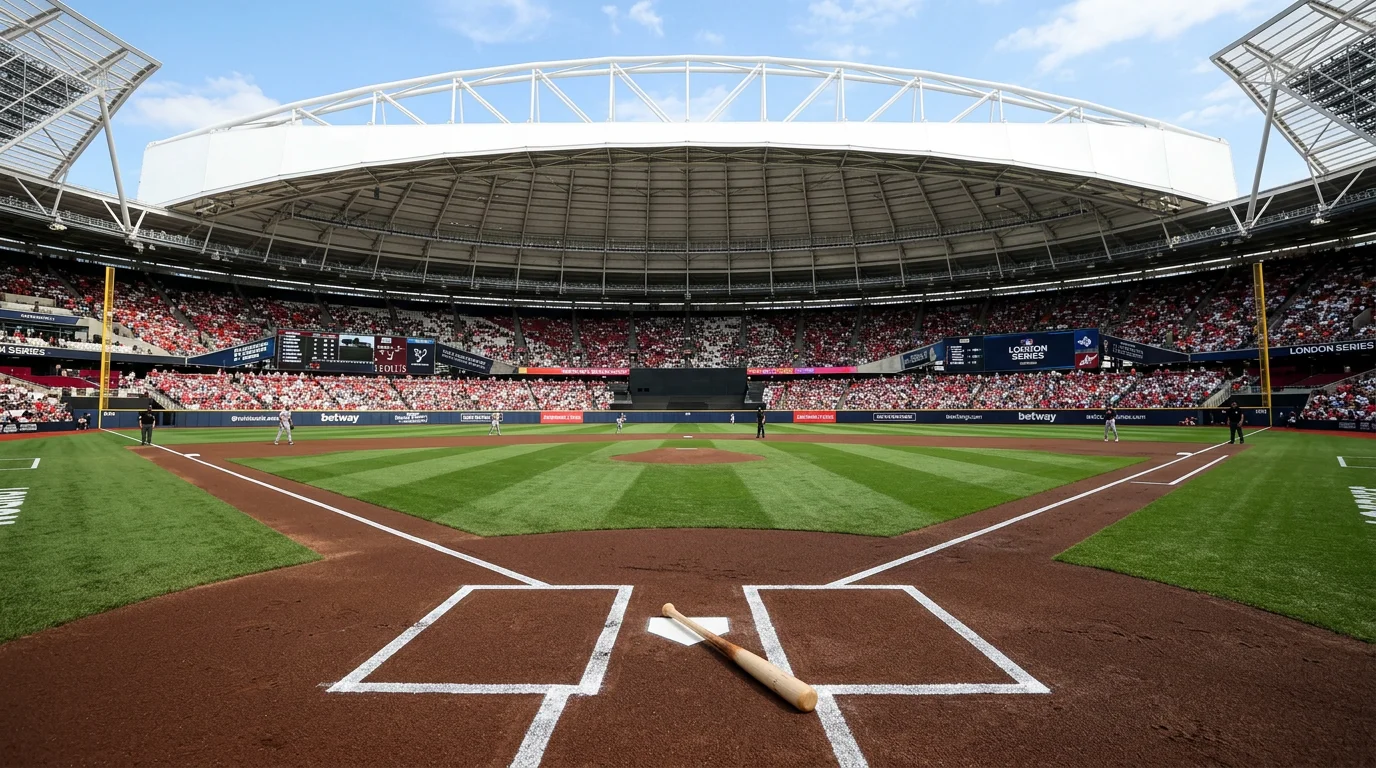
I made my first bet on a London Series game in 2019, lost it inside three innings to a wind-aided home run barrage, and have been preparing differently for every UK edition since. The London Series is the one weekend each summer where the British MLB market wakes up, the bookmakers actually price the card seriously, and casual punters who only watch baseball over a pint suddenly find themselves staking on a sport they barely follow eleven months of the year.
That mix of marquee event, neutral venue and unfamiliar audience produces some of the softest betting markets I track all year. The 2023 edition pulled a 71 percent share of UK MLB engagement and triggered a 43 percent merchandise bump. The commissioner’s office has talked openly about expansion of these neutral-venue games as a strategic priority, framing competitive integrity as the umbrella commitment that lets it happen. For UK punters, that translates into a fixture treated by the bookies like a major football derby: liquid, marketed and ripe for value if you know where to look.
This is the framework I bring to every London Series weekend, updated for what we know about the 2026 fixture so far.
London Series 2026 Fixture Context
The 2026 London Series is a two-game neutral-venue MLB regular-season set hosted at London Stadium, the converted Olympic Park venue used regularly by West Ham and occasionally by athletics. MLB has run editions there in 2019, 2023, 2024 and 2025. The original 2019 edition sold all 120,000 tickets in under an hour, and that ticket-sell-through pace has been broadly maintained since. The 2026 set is set up the same way: two games, Saturday and Sunday, primetime UK kickoff.
From a betting-context point of view, three details matter. The set is an in-season fixture, which means both teams are racing for postseason positioning rather than playing exhibition cricket. One club is designated home, the other away, and that affects line-up rules and bullpen usage. And the schedule disruption matters: travel weeks before and after the London Series have produced statistically detectable form distortions in past editions, which bookmakers do not fully price in.
The other context to keep in mind is what UK customers do during these weekends. Live in-play volume on London Series games dwarfs any normal MLB regular-season game on UK exchanges. That liquidity is fuel for the market but also for soft pricing on novelty props, where the recreational money skews heavily one side and a sharp punter can fade the herd.
London Stadium Conditions
London Stadium plays as one of the more hitter-friendly venues MLB has visited in any neutral-site arrangement. The temporary configuration places relatively short power alleys at 366 feet to centre with a 17-foot wall, generous foul ground in the corners, and a playing surface that is laid over the athletics track infrastructure. The first edition in 2019 produced 50 runs across two games, the highest two-game scoring rate in any neutral-venue MLB pairing on record. Subsequent editions have not all matched that ceiling, but the venue has consistently played above the league-average runs index.
Wind matters more than altitude here. The stadium roof is open, the venue sits relatively exposed near the Lea Valley, and a southwesterly summer breeze pushes balls toward right-centre. UK punters checking the forecast Friday evening get a real edge: a calm-weather card prices very differently from a 12-mph southwesterly card, and bookmakers do not always update their totals quickly enough on Saturday morning.
The temporary mound and infield clay also play harder than what the visiting players are used to. Defensive metrics in past editions have shown a small but consistent uptick in errors and balls in play, which feeds into totals over more than the run line. A run line that looks generous in London context might actually be tighter than expected because games can swing on a single bad bounce in unfamiliar conditions.
Markets Likely to Be Priced Up
UK bookmakers treat the London Series like a shop window. Bet365, William Hill, Paddy Power and Betfair all expand their MLB market depth specifically for these weekends. A typical regular-season Tuesday Padres-Diamondbacks game at a UK book might offer moneyline, run line, totals and a thin set of player props. A London Series game offers all of that plus alternative run lines, alternative totals, first-five-innings markets, runs-in-each-inning props, anytime home-run props for every starter, and a small set of UK-flavoured novelty markets.
The marquee market is the moneyline, and the moneyline is usually the worst-priced of the lot. Public money pours into the favourite. Where I look for value instead is the alternative run line, the first-five totals, and the team-total props for the underdog. A short underdog priced at 2.10 to win outright is often available at 1.65 to score over 3.5 runs, which is a much higher-probability outcome and a friendlier hold. The wider non-MLB market context shows up clearly in the wider non-MLB international view where event-driven pricing always carries softer edges.
One more thing worth flagging: live in-play volatility on these games is larger than a normal MLB market. Lines move three or four runs on a single big swing, and recreational money chasing the swing creates spots for measured pre-priced bets to hold their value.
Home Designation and Betting Impact
One of the quieter quirks of a neutral-venue MLB game is the home-team designation. Even at London Stadium, one team bats in the bottom of the ninth, gets last licks, and uses the home dugout. That designation is not cosmetic. Home teams in MLB win at roughly 53 percent over a full season, and that built-in edge survives even when the actual venue is a converted Olympic park 4,000 miles from anyone’s natural fan base.
For betting purposes, that means the home moneyline is often two to four cents more expensive than it would be on identical merits at a true neutral. UK bookmakers do build that into their lines, but unevenly. Run-line markets tend to absorb the edge less efficiently than moneyline markets, especially when the home team is the small-favourite.
The other subtle effect is bullpen usage. The home team in a London Series game has a manager who knows he can hold his closer for the bottom of the ninth in a one-run game, while the away manager has to consider deploying differently in the top of the ninth in a tied game. Late-inning props on the away closer often get shaded too short on past form, when the actual usage profile in this fixture is materially different.
UK Bookmaker Coverage of the London Series
Coverage of the London Series across the UK regulated market is broader than for any other regular-season MLB fixture. Bet365 historically prices the deepest set of player props. William Hill leans into in-play with strong cash-out support. Paddy Power tends to offer London-Series-specific concession promotions on first-bet refunds and price-boost lists. Betfair Exchange typically has the cleanest pricing on the moneyline, often a tick or two better than the sportsbook side.
What none of them does well, in my experience, is custom novelty props. The “first hit by a British-born player” type markets often appear with hold percentages that are absurd compared to the standard moneyline. I avoid those. Stick to the deeper liquidity markets where line shopping across two or three of the operators above can yield a few points of value on every leg of a stake.
Will the London Series 2026 run-line totals reflect the high offence of past UK editions?
Do UK bookmakers offer London-Series-only specials each summer?
How does the home-team designation in a neutral-venue MLB game affect the betting card?
Material created by the team StitchLine