
I still remember staring at my first US sportsbook MLB page in 2017 and not understanding why a -180 looked larger than +150 yet implied a smaller payout. The American odds format is genuinely confusing to anyone raised on UK fractional or decimal pricing, and the gap matters because most of the serious MLB analytical content a UK punter encounters – line-movement reporting, model outputs, prop pricing analysis – comes packaged in American odds. If you cannot read both formats fluently, you are filtering the most useful information through a translation layer that costs you accuracy and time.
This guide walks through why MLB defaults to American odds, why decimal is the UK norm, the quick mental-conversion rules I use at the screen, worked examples on real MLB scenarios and the operators that let you toggle between formats inside your account.
Why MLB Uses American Odds
American odds developed in US bookmaking culture as a way to express the relationship between a $100 stake and the corresponding profit, with positive numbers indicating underdogs (stake $100 to win the listed amount) and negative numbers indicating favourites (stake the listed amount to win $100). The format is unintuitive on first encounter but produces clean, easily-compared numbers for most realistic price ranges. A line of -110 is the standard “vig” price for two-sided markets, and the symmetry around even money (-100/+100) lets bookmakers price marginal favourites and underdogs on the same scale.
The US legal sportsbook market produced a total handle of $166.94 billion in 2024, and that volume has cemented American odds as the default presentation format across virtually every US-licensed operator’s MLB page. Because MLB is a US sport with US-based market makers setting opening lines, the American format propagates outward from there into the rest of the global betting ecosystem. International books that price MLB do so with American odds visible in trader-facing systems and often in customer-facing displays as well.
For UK punters, the practical consequence is that any time you read US-based MLB analysis – line movement reports, sharp-versus-public splits, projection-model outputs – the numbers will be in American format. A +130 reference in a piece about an undervalued pitcher means nothing useful unless you can convert to 2.30 decimal in your head and check the price at your UK book.
Decimal Format UK Default
Decimal odds express the total return per unit staked, including the stake. A decimal price of 2.50 on a £10 bet returns £25 total (£15 profit plus the £10 original stake). The format is intuitive once you grasp that the displayed number is the multiplier on your stake, and it scales cleanly across the full price range from short-odds favourites (1.10, 1.25, 1.50) through even money (2.00) up to long-shot underdogs (5.00, 10.00, 50.00 and beyond).
The UK regulated betting market generated approximately £2.6 billion in remote gross gambling yield during the 2024-25 financial year, almost all of it transacted in decimal-format pricing as the customer-facing default. UK punters accustomed to fractional odds (3/1, 5/2, evens) have largely transitioned to decimal as exchanges and most online sportsbooks moved to decimal as the primary display option through the 2010s. Fractional remains available as a toggle at most UK books for traditionalists, but decimal is the operational default for serious modelling.
The advantage of decimal for analytical work is clear: implied probability is just 1 divided by the decimal price. A 2.50 price implies 40% probability (1/2.50 = 0.40); a 1.91 price implies 52.36%. American odds require a more cumbersome two-step conversion to reach the same probability calculation, which is why every probability-based betting model I have ever built uses decimal as its native unit.
Quick Conversion Rules
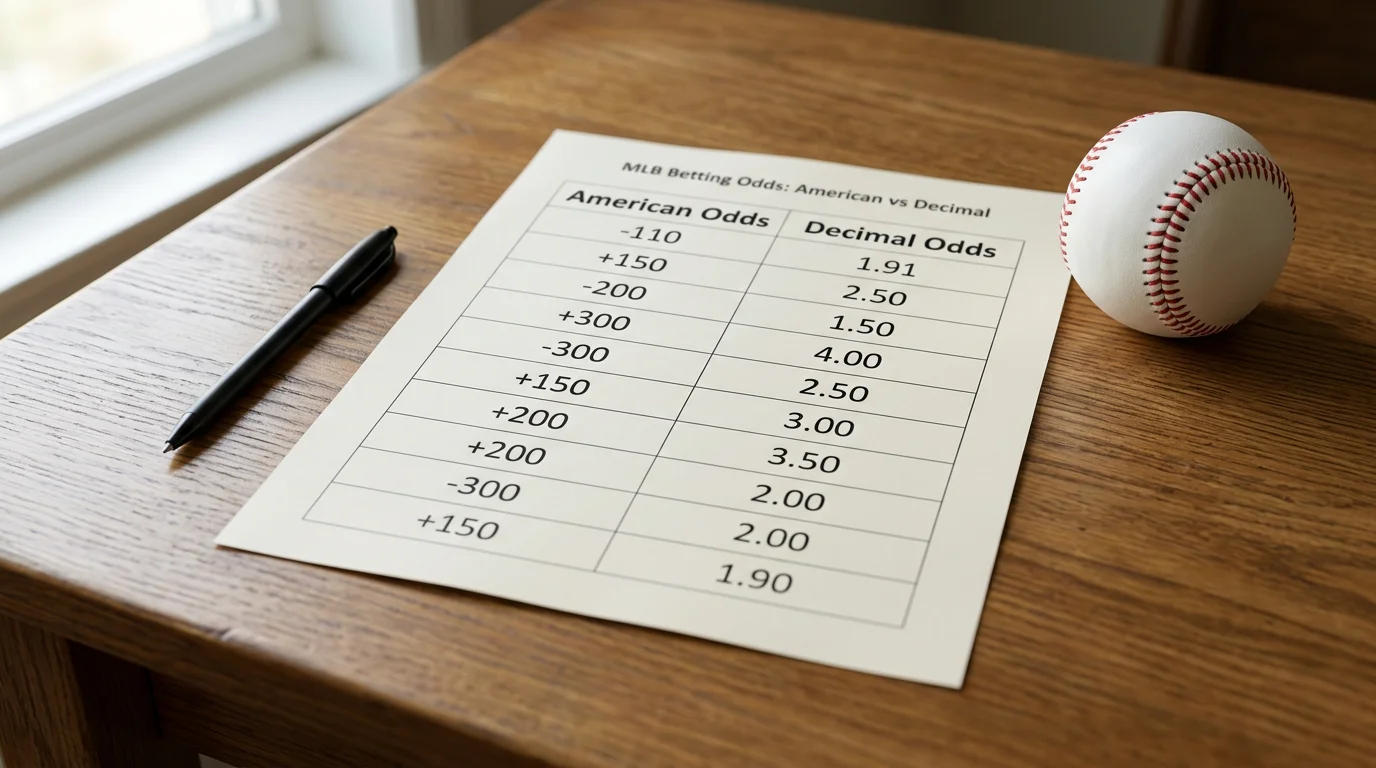
The conversion rules between American and decimal odds are arithmetic and simple once you have done a few. For positive American odds, divide by 100 and add 1. So +150 becomes (150/100) + 1 = 2.50. So +200 becomes (200/100) + 1 = 3.00. So +110 becomes (110/100) + 1 = 2.10. The mental shortcut for any positive American line is: drop two zeros, add one. +130 is 2.30. +250 is 3.50.
For negative American odds, divide 100 by the absolute value and add 1. So -150 becomes (100/150) + 1 = 1.667. So -200 becomes (100/200) + 1 = 1.50. So -110 becomes (100/110) + 1 = 1.909, typically displayed as 1.91. The mental shortcut for negative American is harder because the inverse calculation does not produce clean numbers, but a few benchmarks help: -110 is roughly 1.91, -120 is 1.83, -150 is 1.67, -200 is 1.50, -300 is 1.33.
Going the other direction, decimal to American: for decimals above 2.00, the American positive line is (decimal – 1) × 100. So 2.50 → +150. So 3.00 → +200. For decimals below 2.00, the American negative line is -100/(decimal – 1). So 1.50 → -200. So 1.67 → -150. So 1.91 → -110.
Worked MLB Examples
Take a typical MLB Saturday slate. A road favourite priced at -125 in American format converts to 1.80 decimal. The implied probability is 1/1.80 = 55.56%. If your model has the road team winning 58% of the time, the bet has a 2.44 percentage point edge over the implied price, which is a genuine value spot worth a position. The same calculation in American format would require converting -125 to implied probability via 125/(125+100) = 55.56%, then comparing to the model’s 58%. Same answer, longer arithmetic.
A run-line bet of +1.5 at -150 American converts to 1.67 decimal. A run-line bet of -1.5 at +130 American converts to 2.30 decimal. The decimal format makes it instantly obvious that a £100 stake on the +1.5 side returns £167 total (£67 profit), while the same stake on the -1.5 side returns £230 total (£130 profit). The risk-reward asymmetry is visible in the decimal numbers in a way that requires translation in the American.
For total runs markets, the typical -110 vig price on Over and Under sides converts to 1.91 decimal. A £100 stake at 1.91 returns £191 total (£91 profit) regardless of which side you take. The hold percentage on a two-sided 1.91/1.91 market is roughly 4.76%, which is the standard MLB totals margin at most reputable books. For the underlying mechanics of how moneylines, run-lines and totals interact, my piece on moneyline mechanics in detail walks through the structural pricing relationships across MLB markets.
Which UK Bookies Let You Toggle
Bet365, William Hill, Paddy Power, Ladbrokes, Coral, BetVictor and Betfair all offer odds-format toggles inside customer accounts, with decimal, fractional and American available as the three standard options. The toggle is typically located in account settings under preferences. Once set, the choice persists across sessions and devices linked to the same login, which makes American the practical default for UK punters who model in dollar-denominated systems and prefer matching presentation to their analytical pipeline.
How is +110 different from 2.10 in plain terms?
Which UK bookmakers let me display MLB odds in American format?
Material created by the team StitchLine