

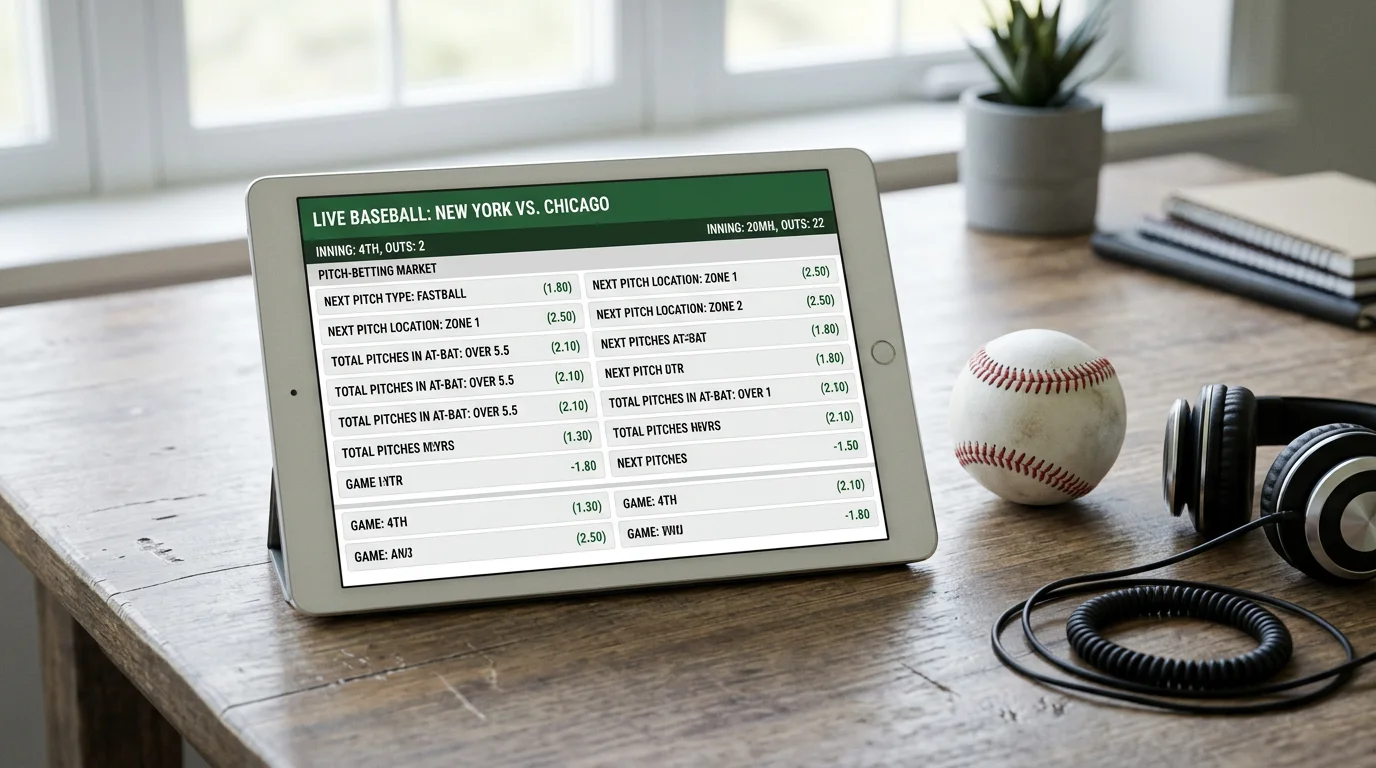
I have been tracking pitch-level micro-markets across US books since they first appeared, and I genuinely thought regulators would tolerate them indefinitely because the volume was small and the bookmaker margins were quietly enormous. Then November 2025 happened. A federal investigation into Cleveland Guardians pitchers Emmanuel Clase and Luis Ortiz produced a series of indictments alleging that pitch-by-pitch outcomes had been engineered to deliver winning prop bets, and within weeks the major US sportsbooks had agreed with MLB to cap pitch-level wagers at $200 per bet and remove them from parlay slips entirely.
The post-Clase rule does not apply directly to UK-licensed bookmakers, but it has reshaped the broader MLB prop landscape that UK punters interact with through international books, exchanges and odds-comparison feeds. This is the cleanest case study I can think of where an integrity scandal forced the betting industry to police itself in real time, and the mechanics matter even if you never bet a single pitch outcome yourself.
The Clase and Ortiz Case Snapshot
The basic facts as reported by the Las Vegas Review-Journal and federal court filings are these: a coordinated betting ring is alleged to have generated roughly $460,000 in profit by placing prop bets on specific pitch outcomes – first pitch a ball, particular pitches not exceeding a certain velocity – that the pitchers themselves are alleged to have engineered to fit. Clase, a four-time All-Star closer, and Ortiz, a starter, were both arrested in connection with the investigation in November 2025. The case is criminal rather than civil, which means MLB’s internal disciplinary process is running in parallel with the federal proceedings, and final sentencing has not been delivered at the time of writing.
What made pitch-level props uniquely vulnerable was the combination of low informational asymmetry from the bookmaker side – these are extremely difficult to model accurately – and high control from the player side. A starting pitcher who decides to throw a deliberate ball as the first pitch of an inning is committing an act that is essentially undetectable from the broadcast booth, but it resolves a prop market that someone in the stands or on a phone has just placed money on. Once you understand that asymmetry, the integrity risk becomes obvious in retrospect.
The case also exposed how thin the volume on these markets actually was. A $460,000 profit run was enough to trigger the kind of pattern recognition that integrity monitors flag, which tells you the underlying handle on these markets was not large enough to absorb that volume without leaving fingerprints. If you want a deeper look at the legitimate prop market that survives this episode, my piece on how strikeout props are still on offer walks through where genuine pricing edges remain.
MLB 200 Cap Rule Mechanics
The agreement that emerged between MLB and the major US sportsbooks set a hard maximum of $200 per wager on any pitch-level prop. That limit applies per individual bet rather than per day, which means a single account cannot place a $5,000 wager on whether a particular pitch will be a strike, but they can place multiple $200 wagers across different pitches. The rule sits inside the existing data-rights and integrity agreements between the league and licensed operators, and it took effect through bookmaker self-regulation rather than statutory law in most US states.
Ohio Governor Mike DeWine was sceptical about whether a $200 cap was the correct tool. His public commentary, paraphrased, ran along the lines that the cap addressed the symptom rather than the disease, and that some categories of micro-bet probably should not exist at all rather than exist with a ceiling. That view has support among integrity researchers who argue the structural vulnerability of pitch-level markets is fundamental rather than fixable through bet-sizing limits.
The counter-argument from the bookmaker side is that a $200 cap reduces the expected value of any coordinated manipulation below the threshold where the legal risk of organising a betting ring makes economic sense. If you cannot turn $460,000 in clean profit through pitch manipulation, the conspiracy economics break down. Whether that argument holds up in practice depends on enforcement consistency across operators, and that is exactly where the next layer of the rule gets complicated.
Why Parlays Are Now Excluded
The second component of the rule, often less discussed, is that pitch-level props can no longer be combined into parlays at the participating sportsbooks. This is significant for two reasons. First, parlays are where the bookmaker margin is highest on prop markets – combining four pitch-level legs at slightly off-true prices compounds the implied hold to genuinely punitive levels – so removing them is a real revenue concession from the bookmaker side. Second, parlays were the primary mechanism through which a coordinated ring could amplify a small per-pitch edge into the kind of payout that justified the manipulation in the first place.
If the maximum bet on a single pitch outcome is $200, but you can parlay ten such pitches at +200 each, the theoretical payout on a $200 stake balloons into the hundreds of thousands. Removing parlay eligibility flattens that payoff curve dramatically. A run of ten correct $200 singles at +200 returns $6,000 in profit rather than several million, which is the kind of money that does not justify the criminal exposure of organising the scheme.
The parlay exclusion also has a softer effect on the casual market. A lot of recreational pitch-prop volume came from punters adding a pitch leg to an existing same-game parlay almost as a flutter. That volume disappears under the new rule, which is part of the reason some commentators expect pitch-level markets to wither rather than thrive even at the $200 cap.
Which Bookmakers Are Bound
The agreement covers the official MLB betting partners, which between them hold the data-feed licences and the integrity-monitoring relationships. By the most cited industry figure, those operators represent approximately 98% of the legal US sportsbook market by handle. That is essentially every name a US punter would recognise – DraftKings, FanDuel, BetMGM, Caesars and the smaller licensed regionals – operating under the same self-imposed ceiling.
What the rule does not cover is the offshore market, where pitch-level props remain available without caps in some books. It also does not cover UK-licensed operators, because UK bookmakers are governed by the Gambling Commission and do not generally hold MLB data-rights agreements in the same form as their US counterparts. Most UK books that price MLB do so through international feeds and tend not to offer pitch-level granularity in the first place, so the practical effect on a UK account is close to zero.
The exception that matters is the exchange model. Betfair and similar peer-to-peer venues do not offer pitch-level props as standard, but the underlying mechanism – punters pricing each other on bespoke micro-markets – is theoretically capable of supporting them. So far there is no evidence that exchanges are planning to fill the gap left by the US sportsbook withdrawal, and the regulatory headwinds suggest they would not want to.
UK Implications for Punters
For a UK punter, the immediate practical consequence of the post-Clase rule is essentially nil. You probably never had access to American-style pitch-level props on a Bet365 or William Hill MLB page, because UK books have always priced MLB at the macro level – moneyline, run-line, totals, strikeout props, home-run props – rather than the pitch level. The post-Clase rule consolidates that conservative posture across the wider market, which means the UK MLB betting menu will continue to look much as it did in 2024 and 2025.
The indirect effect is more interesting. Integrity scandals tend to compress operator risk appetite across the board, not just in the affected market. Expect to see slightly tighter limits on adjacent prop markets – pitcher hits-allowed, batter strikeout overs, first-inning total runs – over the coming season as books adjust their integrity-monitoring thresholds. This will not be announced publicly, but it will show up in stake-rejected screens and in reduced upper limits for accounts that consistently take prop markets.
The longer-term effect on UK MLB pricing depends on whether the post-Clase episode triggers a broader review of micro-market exposure under UK Gambling Commission oversight. There is no indication of that yet, but the precedent has been set. If you bet MLB through a UK account, the worst-case outcome of further integrity tightening is mildly tighter prop pricing on the markets that already exist. That is not a disaster, but it is worth tracking because the prop market is exactly where the residual edges sit for a stake-modelled bettor.
Does the $200 cap apply to UK-licensed bookmakers under MLB's umbrella?
Can a pitch-level prop still be cashed out if it cannot enter a parlay?
Did the Clase / Ortiz case actually finalise in court yet?
Material created by the team StitchLine